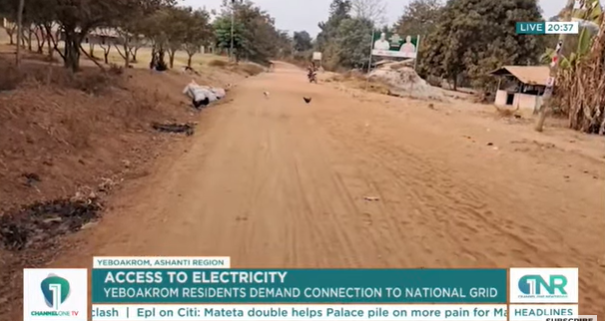
Residents of Yeboakrom, located in the Juaben Municipality of the Ashanti Region, have lamented over the lack of electricity in the community as they are forced to travel long distances on poor roads just to charge their mobile phones in a neighbouring town.
Frustrated by these challenges, they lament the hardships of life in their community.
For 27-year-old Abena Fowaa, living in Yeboakrom is both stressful and monotonous due to the lack of basic amenities.
Like many others in the community, she must walk to nearby towns just to charge her phone or store perishable goods.
She describes how the absence of electricity has made life increasingly difficult for residents.
“Initially there were solar plants. We benefitted from it by using it in commercial ventures. But it is no longer the case. We go to nearby communities to be able to charge our phones. Teachers do not even accept postings to this community due to the lack of electricity,” she said.
The most pressing concerns for Yeboakrom residents are the lack of electricity and the poor road network.
Additionally, access to clean water remains a challenge, largely because the community is not connected to the national grid.
“Light is everything otherwise God wouldn’t have given us day and night. We plead with the government to bring us light and fix our roads as well,” Prosper Fianyeku, another resident said.
“It is not easy for people like us with sight problems, especially at night. We can only appeal to the government to connect us to the national grid and fix our roads for us,” lamented Maame Kyerewaa, another resident of Yeboakrom.
The previous Akufo-Addo-led administration claimed to have achieved over 80% electricity coverage in Ghana, yet communities like Yeboakrom remain without power.
In 2019, Professor Rexford Asasie Oppong, an architecture professor at Kwame Nkrumah University of Science and Technology (KNUST), spearheaded a project to provide solar panels for the community.
This initiative was funded by DAAD-Germany through the Technical University of Munich.
However, the solar power system was later disconnected due to excessive demand on the panels.
Professor Oppong has since introduced new initiatives to raise funds, aiming to connect Yeboakrom to the national grid.
In response, residents have taken matters into their own hands by pooling resources to purchase electricity poles as part of a self-help project.
Community leaders are now urging the government to intervene, provide electricity, and improve their roads.
For now, the people of Yeboakrom continue to live without electricity, waiting for much-needed support to change their reality.
Mahama: ‘Africa must move beyond exporting raw materials to producing finished goods’