
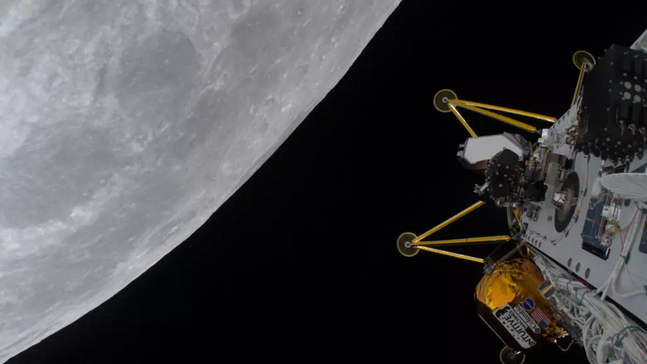
US company Intuitive Machines will attempt its second Moon landing on Thursday, targeting highland terrain near the Moon’s south pole.
Its landing craft, Athena, is set to deploy three rovers, a unique hopping drone and a drill to search for ice and other chemicals beneath the lunar surface.
A drill to search for ice. A 4G network test. Three rovers and a first-of-its-kind hopping drone.
After becoming the first private firm to land on the Moon last year, Intuitive Machines is aiming for its second lunar touchdown on Thursday, carrying cutting-edge payloads to support future human missions.
The Houston-based company is targeting no earlier than 12:32 pm ET (1732 GMT) at Mons Mouton, a plateau near the lunar south pole – farther south than any robot has ventured.
NASA will livestream the landing an hour before touchdown as Athena, the 15.6-foot (4.8-metre) hexagonal lander – about the height of a giraffe – begins its descent.
“It kind of feels like this mission is straight out of one of our favorite sci-fi movies,” said Nicky Fox, NASA’s associate administrator for science.
Intuitive Machines’ first landing in February 2024 was a landmark achievement but ended with its lander tipping onto its side, an outcome the company is determined to avoid this time.
The pressure is on after Texas rival Firefly Aerospace successfully landed its Blue Ghost lander on Sunday, becoming the second private company to reach the Moon.
Both missions are part of NASA’s $2.6-billion Commercial Lunar Payload Services (CLPS) program, which partners with private industry to cut costs and support Artemis, the initiative to return astronauts to the Moon and eventually reach Mars.
A hopper named Grace
Athena is targeting highland terrain about 100 miles (160 kilometres) from the Moon’s south pole, where it will deploy three rovers and a unique hopping drone named Grace, after late computer science pioneer Grace Hopper.
One of Grace’s boldest objectives is a hop into a permanently shadowed crater, a place where sunlight has never shone – a first for humanity.
While NASA’s Ingenuity helicopter proved flight is possible on Mars, the Moon’s lack of atmosphere makes traditional flying impossible, positioning hoppers like Grace as a key technology for future exploration.
MAPP, the largest of Athena’s rovers and roughly the size of a beagle, will assist in testing a Nokia Bell Labs 4G cellular network linking the lander, itself, and Grace – technology designed to one day integrate into astronaut spacesuits.
Source: France 24